Study projects 76% to 140% more cloud-to-ground lightning by century’s end under high emissions
The result comes from a model trained on a single year of data and sits far above earlier estimates. The authors acknowledge large uncertainty, especially in the tropics.
Key points
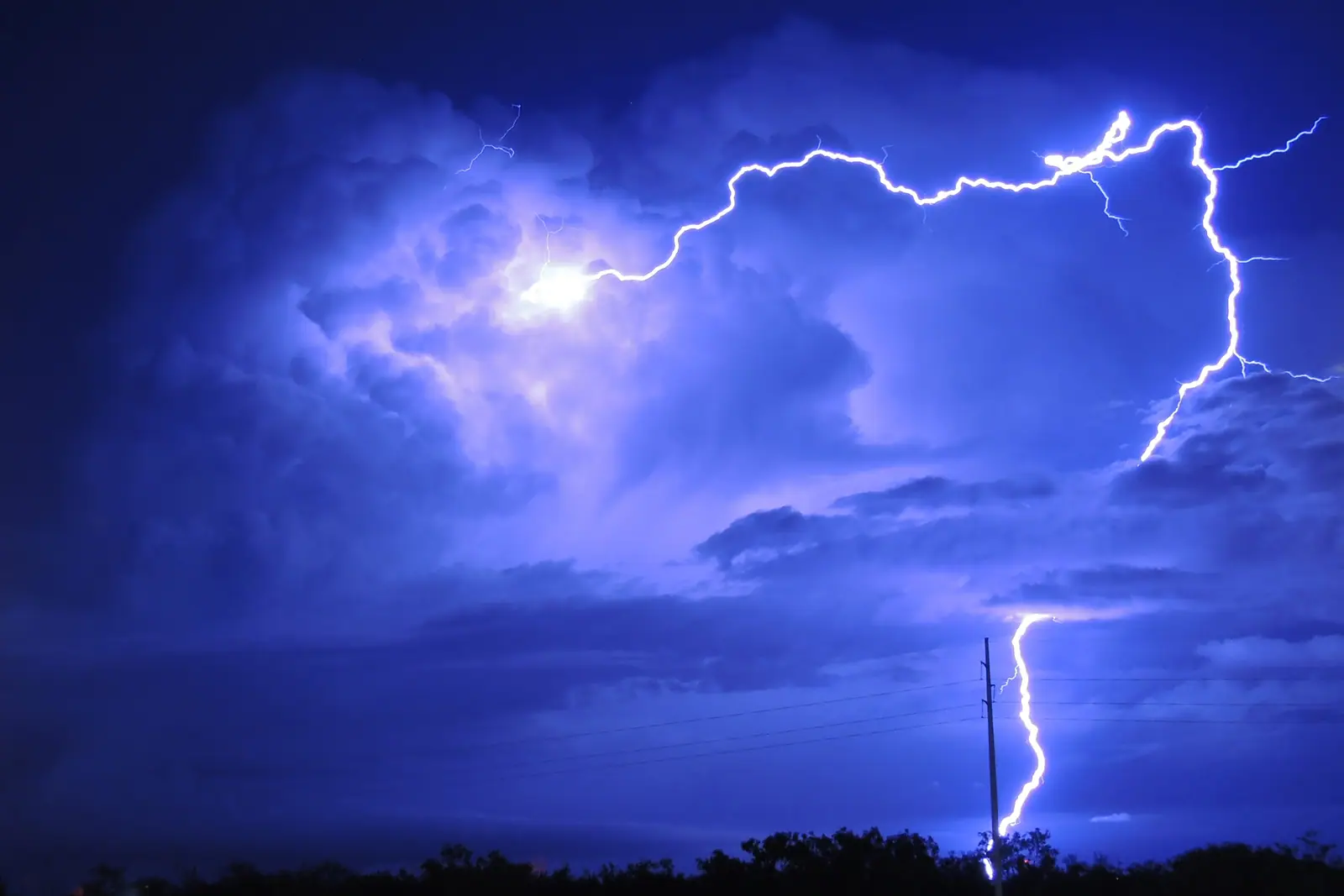
- Lightning that touches the ground could become 76% to 140% more frequent by the end of the century, against 1995–2014, in a high-emissions scenario, according to a study in the journal Earth’s Future.
- The model estimates a rise of about 30% for every degree of warming under high emissions, against about 12% per degree in the twentieth century.
- The highest earlier estimates ran from 8% to 17% per degree; a review by the same author gives a mean of 7.7% per degree across existing lightning projections.
- The largest absolute rise is projected in the tropics, but the Amazon is the most uncertain projection; Alaska could see 116% to 594% more cloud-to-ground lightning.
- The release gives no figures for Portugal or Europe, and the results are model projections, not forecasts.
Lightning that strikes the ground could become 76% to 140% more frequent by the end of the century if greenhouse gas emissions stay high, according to a study in the journal Earth’s Future (opens in a new tab). The comparison is with 1995 to 2014 and applies to land areas across the planet, in a high-emissions scenario. The press release from the American Geophysical Union (AGU) (opens in a new tab), issued on 24 November, says the result is far higher than earlier estimates.
What the study calculated
The work is led by Andreas Krause, who studies the Earth system at the Technical University of Munich (TUM). His team looked at cloud-to-ground lightning: the bolts that touch the surface and cause fires and damage to wind turbines, power lines and other structures. According to the release, these bolts kill several thousand people and hundreds of millions of trees a year worldwide.
The researchers trained a machine-learning model on lightning and climate observations from 2019: temperature, rainfall, humidity, air pressure, wind speed and solar radiation. Applied to the climate of 1901 to 1920 and of 1995 to 2014, the model indicated that cloud-to-ground lightning rose 11% over the twentieth century, about 12% for every degree Celsius of warming.
In a high-emissions future (the SSP3-7.0 scenario), the sensitivity to warming nearly triples, to about 30% per degree. The 76% and 140% are the extremes obtained with two climate models, MPI-ESM1-2-HR and UKESM1-0-LL: a frequency between 1.76 and 2.40 times that of the reference period.
The highest earlier estimates pointed to 8% to 17% per degree. The gap comes mostly from the mathematical methods and from a newer global lightning dataset. Krause said he “was quite surprised” that the numbers came out so high.
Why lightning is hard to predict
Lightning needs both heat and ice. Warm air near the ground rises (this is convection) and stirs the clouds, where tiny ice crystals collide and exchange electric charge until the electric field is strong enough for a discharge. More heat can mean more convection. It could also mean fewer ice crystals high up, which would make lightning harder to form. Krause said it is “not quite clear” which of the two matters more.
That uncertainty shows in a review by the same author, published on 18 November in Atmospheric Chemistry and Physics (opens in a new tab). It collects existing projections for global lightning frequency, which run from an 11% decrease to a 44% increase per degree of warming, with a mean of 7.7% per degree overall.
The review notes that most methods calculate total lightning and that cloud-to-ground bolts are seldom worked out directly. The new study’s 30% per degree sits far above that mean, though inside the range, and the two values do not measure exactly the same thing.
Where there could be more lightning
The study projects the largest rise in the total number of strikes in the tropics, where lightning is already most common, especially the Amazon, Southeast Asia and Oceania. The Amazon is also the most uncertain projection, because its climate could end up very different from the one used to train the model. Some other studies foresee less lightning in the tropics.
The biggest relative increases appear at high latitudes, where lightning is rare today. In Alaska the model points to 116% to 594% more cloud-to-ground lightning than in the reference period, when most of the territory received, on average, less than one strike per square kilometre a year.
What it could mean for people and forests
The release gives no figures for Portugal or for Europe. In 2025, in a study on forests, Krause said models point to the increase mainly at middle and high latitudes, which would make tree deaths from lightning more relevant in temperate and boreal forests. In that work the team estimated that lightning kills about 320 million trees a year, according to a TUM press release (opens in a new tab).
As for people, Krause says the danger may depend on whether lightning rises early in storms, when someone is more likely to be caught outdoors by surprise. The study did not look at how forests would respond. Conifers tend to suffer more visible damage than broadleaved trees, but, Krause said, there is little information on which species cope best.
What is still unknown
The range of 76% to 140% is a model projection for a high-emissions scenario, not a forecast of what will happen. It depends on real emissions, on the climate model and on training with a single year of data, and the same author’s review shows that other approaches give very different results.
Still unclear are the effect in the tropics, above all the Amazon and New Guinea, and what the rise means for the real risk of fires and damage to power networks. The study is by five researchers from TUM, Vrije Universiteit Amsterdam and the University of East Anglia, and was funded by the German Research Foundation (DFG) and the Velux Stiftung.
Sources
Documents and reporting consulted for this story.
- Large Projected Increase in Cloud-to-Ground Lightning Under Future Climate (opens in a new tab)Earth's Future, AGU (resumo e ficha, registo Crossref), . Primary source. Accessed 24 November 2026
- Lightning could strike more than twice as often in a warming world (opens in a new tab)American Geophysical Union (comunicado, via Phys.org), . Primary source. Accessed 24 November 2026
- Lightning in global chemistry-climate models: a review of parameterizations, evaluations, and future projections (opens in a new tab)Atmospheric Chemistry and Physics, . Primary source. Accessed 24 November 2026
- 320 million trees are killed by lightning each year (opens in a new tab)Universidade Técnica de Munique (comunicado, via EurekAlert), . Primary source. Accessed 24 November 2026
Topics

Written by
Wellinton OliveiraCEO of Lyntev
Technology with context, original analysis and sources you can consult.