Euclid discovers the most distant quasar yet, seen 630 million years after the Big Bang
The object beats Euclid’s own record by 40 million years and raises a question: how did a black hole of 360 million solar masses grow so fast?
Key points
- ESA’s Euclid telescope has discovered quasar J1504+6252 (“Dún Aonghasa”), the most distant known, with a redshift of 8.13: we see it 630 million years after the Big Bang.
- James Webb observations point to a black hole of about 360 million solar masses, between 210 and 780 million depending on the method; Keck, Hubble and the Large Binocular Telescope helped confirm the object.
- It beats by 40 million years Euclid’s previous record, a quasar with a redshift of about 7.77 (670 million years after the Big Bang).
- The quasar feeds slowly, so its black hole must have grown very fast in the past or been born very massive; the authors find the result consistent with the direct collapse of a gas cloud.
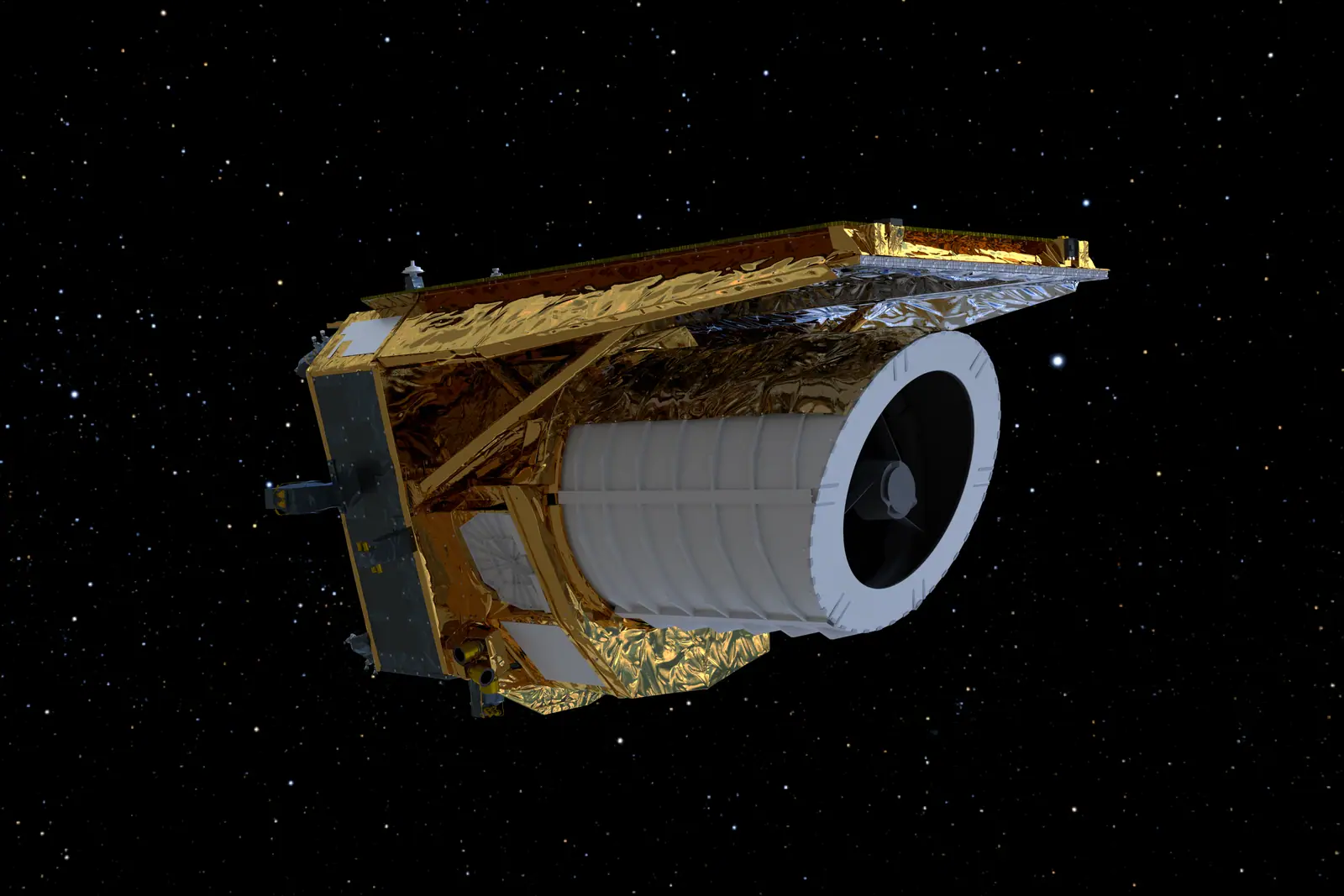
Euclid, the space telescope run by the European Space Agency (ESA), has found the most distant quasar known: the core of a galaxy we see as it was 630 million years after the Big Bang. It is powered by a black hole about 360 million times the mass of the Sun. According to ESA (opens in a new tab), the object, J1504+6252, beats by 40 million years the record Euclid itself set only a few months ago. The study was published on 24 November in the journal Astronomy & Astrophysics.
What was found
A quasar is the extremely luminous core of a galaxy, where gas falls onto a supermassive black hole and releases so much energy that the core can outshine the rest of the galaxy. It is a brief phase in a galaxy’s life. The team nicknamed this one “Dún Aonghasa”, after a prehistoric fort on the Irish island of Inis Mór, on the Atlantic edge of Europe.
The quasar’s redshift is 8.13. This measures how much the wavelength of its light has been stretched by the expansion of the Universe on the way to the telescope, and the distance is deduced from it. It is the first quasar identified beyond redshift 8. ESA translates the value into light that left about 13.1 billion years ago, when the Universe was roughly 5% of its present age.
How it was found
Euclid spotted it in about 18 months of data, among millions of objects. Several observatories then confirmed what it was. The W. M. Keck Observatory, in January 2026, and the Hubble Space Telescope, in May, gave the first hints. The Large Binocular Telescope, days later, and the James Webb Space Telescope, in June, revealed the redshift. The dates come from the preprint of the paper (opens in a new tab), dated 11 September and posted by the Max Planck Society.
Webb was also used to weigh the black hole. The reference value is about 360 million solar masses, but the margin is wide. With several methods, the paper finds values between about 210 and 780 million, a conversion of the logarithms 8.33 and 8.89 the authors publish.
Julien Wolf leads the team. He did the work at the Max Planck Institute for Astronomy (MPIA), in Heidelberg, and has since moved to the European Southern Observatory in Garching, says the release issued by the Max Planck Society (opens in a new tab).
The arithmetic of the record
The previous record was Euclid’s too. In July the team of Daming Yang submitted to the scientific repository arXiv a paper with 31 quasars, picked from about 3,000 square degrees of sky observed in the survey’s first year and a half, according to its abstract (opens in a new tab). The most distant had a redshift of about 7.77, which corresponds to 670 million years after the Big Bang, according to ESA (opens in a new tab).
From 670 to 630 million years is the 40 million that ESA mentions. The new paper puts the previous record holder at about 660 million years and the gap at 39 million.
The pace of discovery has picked up. ESA notes that Euclid has already announced 31 ancient quasars in a year and a half. The 12 beyond redshift 7 more than doubled what was known at that distance, a threshold that took 15 years to reach with earlier surveys. At redshift 8, the agency expects at most a few tens of quasars in Euclid’s whole survey.
The puzzle: how it grew so fast
Unlike other very distant quasars, this one is feeding at a relatively slow rate. If the black hole reached this mass in so little time, it must have grown very fast in the past, which, ESA says, puts pressure on models of black hole formation in the young Universe.
The MPIA explains the reasoning. The closer to the Big Bang a quasar is found, the faster its black hole must have grown, or the more massive it must have been at birth, or both, says Wolf. The team worked out under what conditions the proposed scenarios could produce a black hole like this one. With reasonable growth rates, the result is consistent with direct collapse, in which a very massive gas cloud condenses and forms a black hole straight away, which then keeps growing.
That growth normally has a ceiling, the Eddington limit: a self-regulating mechanism that, at ever higher temperatures, pushes back the infalling gas. According to the MPIA, the data show the quasar growing far below that limit; the paper estimates between 12% and 44% of it, depending on the method. Had it always grown this slowly, it would have needed an enormous initial “seed”, which is hard to explain with current models. The alternative is much faster growth in the past, perhaps even beyond the theoretical limit.
What is still unknown
According to the MPIA, the conditions for direct collapse must have been rare in this era, which could explain why so few quasars are known beyond redshift 7.5. If quasars are found at much earlier times, when the Universe was just a few hundred million years old, even that scenario may become less likely. In that case astronomers might have to consider a more exotic idea: primordial black holes, formed right after the Big Bang, which would act as massive seeds. Only new observations will settle the question.
The scientific paper, by J. Wolf and colleagues, has the DOI 10.1051/0004-6361/202662243.
Sources
Documents and reporting consulted for this story.
- Euclid breaks own quasar record by 40 million years (opens in a new tab)Agência Espacial Europeia (ESA), . Primary source. Accessed 24 November 2026
- New quasar record tightens constraints on black hole formation scenarios (opens in a new tab)Sociedade Max Planck, . Primary source. Accessed 24 November 2026
- Euclid: Discovery of Dún Aonghasa, a quasar at z = 8.13 hosting a 360-million-solar-mass black hole (versão preliminar) (opens in a new tab)J. Wolf e colegas, via Sociedade Max Planck, . Primary source. Accessed 24 November 2026
- Euclid discovers the most ancient quasar in the Universe (opens in a new tab)Agência Espacial Europeia (ESA). Primary source. Accessed 24 November 2026
- Euclid: Discovery of 31 new quasars at 6.6 < z < 7.8 (opens in a new tab)arXiv (A&A 711, A104), . Primary source. Accessed 24 November 2026
Topics

Written by
Wellinton OliveiraCEO of Lyntev
Technology with context, original analysis and sources you can consult.