Scientists build digital twins of 6,986 brains to study ageing and dementia
The models, fitted to brain scans of people aged 18 to 100, already reveal patterns tied to age and diagnosis. The authors speak of associations with the environment, not causes.
Key points
- An international team built personalised computer models, “digital twins”, of the brains of 6,986 people in 16 countries, aged 18 to 100.
- Each twin represents 90 brain regions and was tuned to a resting-state functional MRI scan; the authors are sharing the code and more than three million simulations.
- Age was the factor most closely linked to the regularity of simulated activity, and frontotemporal degeneration departed furthest from the healthy pattern.
- Associations with the environment appeared in seven of ten domains, such as air pollution, soil and water quality and democratic conditions.
- The next step is to test whether the twins can anticipate changes in people over time or after an intervention.
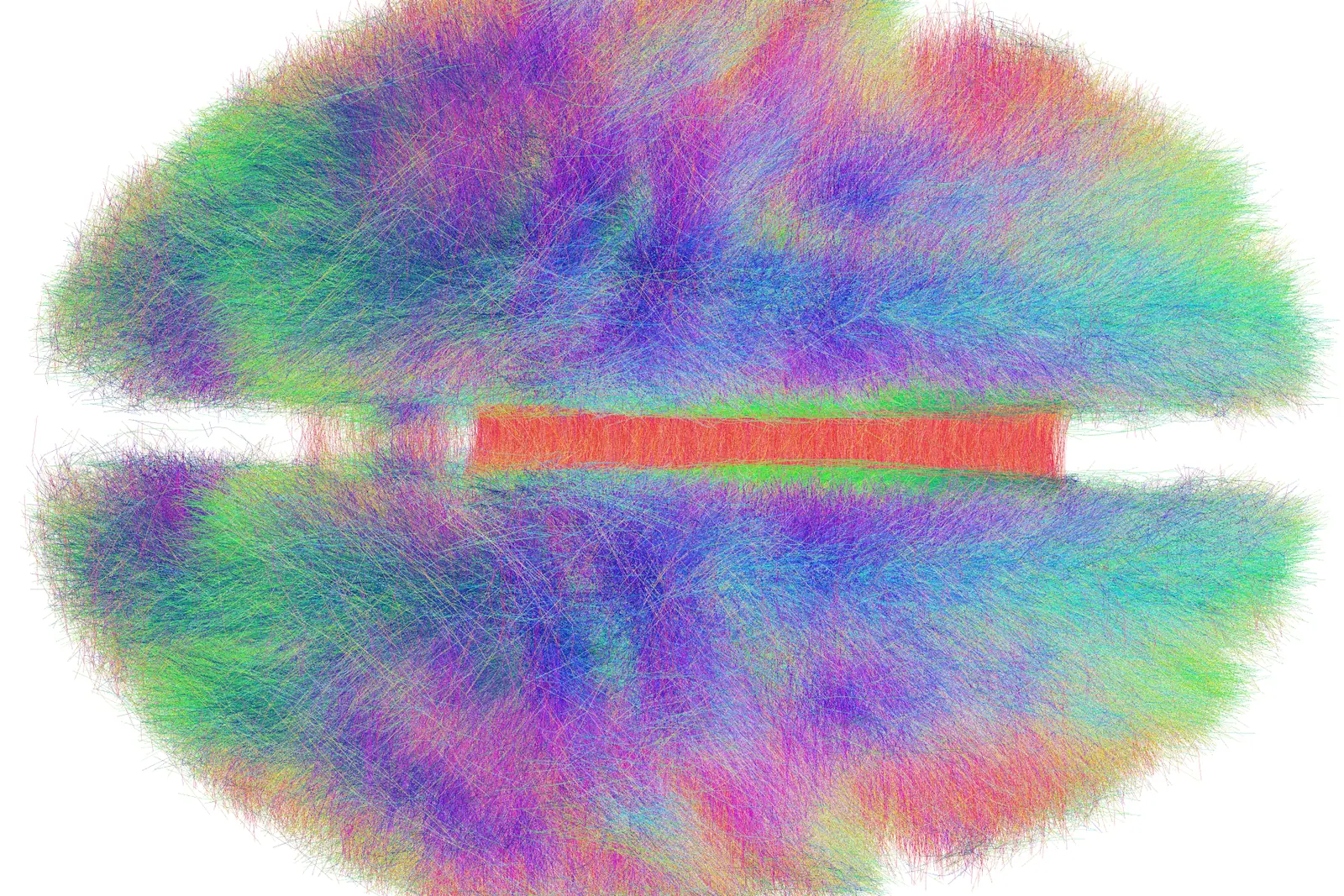
An international team has built computer replicas, “digital twins”, of the brains of 6,986 people in 16 countries to study how ageing, neurodegenerative disease and the environment relate to the way the brain works. The work, published on 23 November in Nature Biomedical Engineering (opens in a new tab), shows patterns tied to age and to diagnoses such as Alzheimer’s disease, but it speaks of associations with the environment, not causes.
What the scientists did
The researchers started from functional magnetic resonance imaging (MRI) scans of people aged 18 to 100, which record brain activity indirectly. Each scan was used to build a personalised computer model, based on equations that represent biological processes in the brain.
The first author is Rubén Herzog, a professor at the University of the Balearic Islands, and the corresponding author is Agustín Ibáñez, of the BrainLat institute in Chile and Trinity College Dublin. According to the paper’s abstract, the individual models fitted the data better than models built for groups of people. The work produced more than three million simulations, which the authors are making available to other scientists.
How a twin is built
Each model represents 90 connected brain regions. The researchers tuned it until its virtual scan signals closely matched the person’s real resting-state recordings. That lets them estimate processes the scan does not show directly, such as the balance between signals that excite neurons and those that restrain them.
To check whether a model is close to reality, the team compared the excitability calculated for each region with grey matter volume, an independent measure. The two were correlated, which the authors say indicates that the models fit well.
“Each twin acts as a personalised virtual laboratory,” Ibáñez says in the news release (opens in a new tab). Researchers can change how groups of neurons interact and observe the effect on the whole brain.
What the models already show
Of the factors examined, age was the one most closely tied to how steady, or how erratic, the simulated activity was as it rose and fell over time. The differences between healthy participants and people with mild cognitive impairment, Alzheimer’s disease or frontotemporal degeneration combined three things: how much activity there was, how much it varied, and how signals that excite neurons were balanced against those that inhibit them.
Frontotemporal degeneration departed furthest from the healthy pattern. According to the release, that departure did not mean activity that was always higher or always lower across the brain.
The link to the environment
The team set the models beside indicators of the places where people live and found associations in seven of the ten domains it looked at. The strongest were with sets of indicators on democratic conditions in the country (free choices, participation, political representation and the rule of law), soil and water quality, and air pollution.
A complementary analysis using individual social data also pointed to associations with access to healthcare, childhood experiences and financial circumstances. The main results held after adjusting for age, sex, diagnosis, country, MRI scanners and data quality, the authors say.
These are statistical associations. The paper’s abstract says the strongest involve the social and the physical environment, in this case pollution, and that the models captured 68 combinations of environmental influences.
What they could be used for
In the long run the authors want to use these virtual laboratories to understand why a brain becomes vulnerable and which biological changes could give it back healthier functioning. “In the future, they could even help guide personalised interventions in the brain,” Ibáñez told the Spanish agency Efe, as reported by Portugal’s Lusa (opens in a new tab).
The release gives examples of future experiments. One is to feed the models with data from measures that clean the air or widen access to healthcare, to simulate the effect on brain activity. Another is to add maps of neurotransmitter receptors and test changes in the signalling of glutamate and GABA, two chemical messengers that broadly raise and lower the activity of neurons, respectively. Researchers would then ask whether those changes move simulated activity towards the pattern of healthy people of a similar age.
What is still unknown
The next step, the authors say, is to test whether the twins can anticipate changes seen in people over time or after an intervention. Until then, it has not been shown that the models predict what will happen to any one person.
The team is sharing the code, the model parameters and the simulations so that other researchers can repeat the analyses and design new virtual experiments.
Sources
Documents and reporting consulted for this story.
- Scientists build nearly 7,000 ‘digital brain twins’ to explore aging, dementia, and the exposome (opens in a new tab)EurekAlert! (comunicado dos autores), . Primary source. Accessed 24 November 2026
- Criados 7.000 cérebros digitais «gémeos» para investigar a mente humana (opens in a new tab)Observador (Lusa), . Accessed 24 November 2026
- Biophysical brain twins map the phenotype–expotype architecture of ageing and dementia (opens in a new tab)Nature Biomedical Engineering, . Primary source. Accessed 24 November 2026
Topics

Written by
Wellinton OliveiraCEO of Lyntev
Technology with context, original analysis and sources you can consult.