BepiColombo enters Mercury orbit despite software fault during its braking burn
The thrusters stopped early, leaving the European-Japanese mission in an orbit that takes 75 hours to complete instead of 58. ESA has redrawn the plan and still expects the two probes to separate in December.
Key points
- BepiColombo, run by the European Space Agency (ESA) and Japan’s JAXA, entered orbit around Mercury on 21 November 2026, eight years after launch.
- The braking burn was meant to last 37 minutes but the spacecraft cut it short: it achieved about 77% of the planned change in speed and went into safe mode.
- ESA attributes the shutdown to a software problem involving the craft’s orientation and thruster control; the investigation with Airbus continues.
- Each lap of the planet takes 75 hours, rather than the 58 planned. ESA says no extra burns are needed and the final science orbit is unchanged.
- The MPO (European) and Mio (Japanese) probes are due to separate on 9 December (10 in Japan), and the scientific study of Mercury is planned to start in April 2027.
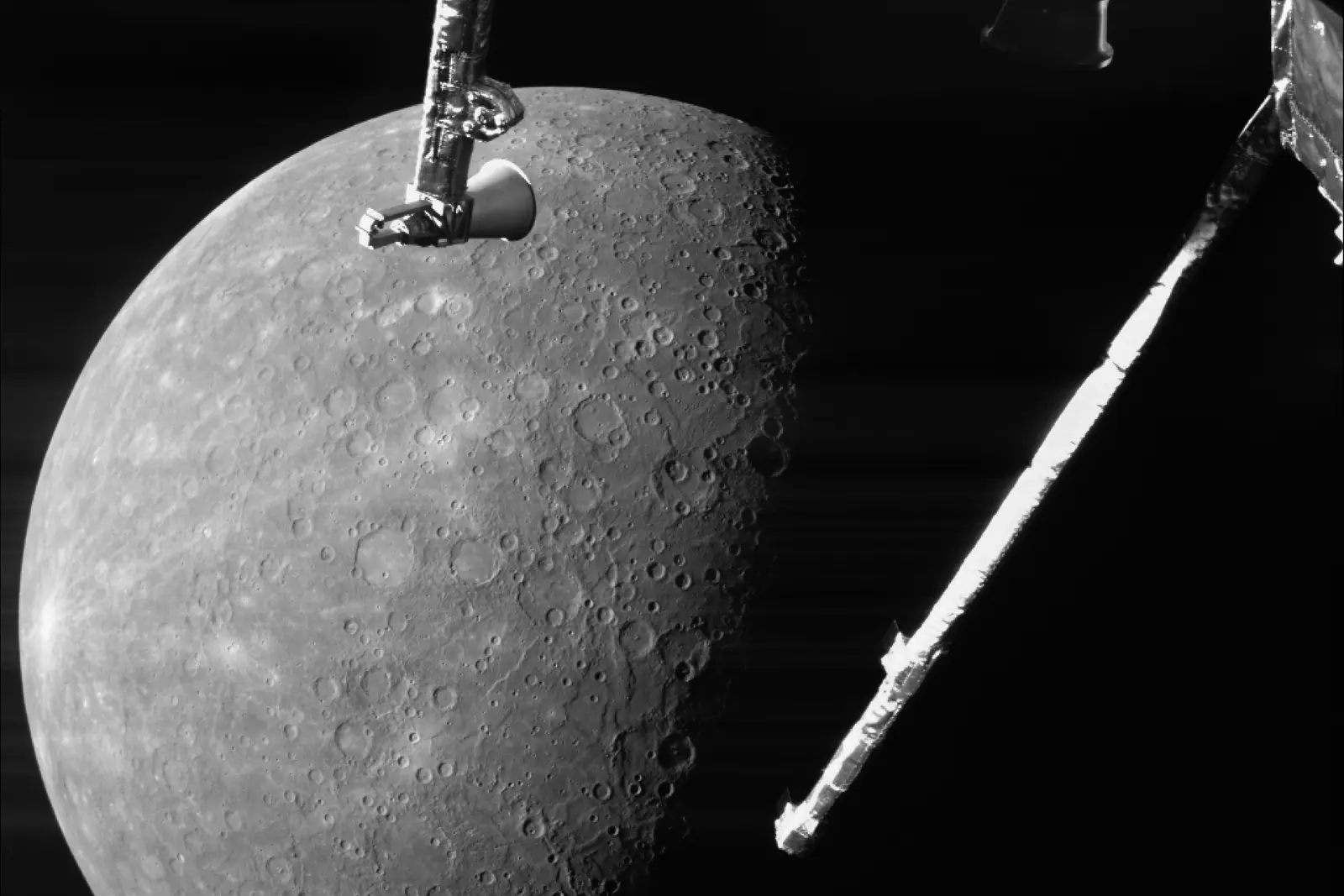
BepiColombo, a joint mission of the European Space Agency (ESA) and the Japan Aerospace Exploration Agency (JAXA), has been circling Mercury since Saturday 21 November. Its arrival after eight years in space did not go entirely to plan: the thrusters slowing the craft shut down early because of a software problem. ESA says (opens in a new tab) the spacecraft is safe, the orbit is stable and the next steps keep their dates.
What happened on arrival night
The instructions had been uploaded beforehand so that the craft could carry them out alone. At 16:51 UTC it swung round into braking position and, as expected, went out of touch with Earth. At 18:24 UTC, 635 kilometres above the surface, it lit four chemical thrusters to slow down. The burn, as engineers call such a firing, was due to last 37 minutes.
When the antenna at New Norcia in Australia picked up the signal again, the data held a surprise. The craft had halted the manoeuvre of its own accord and switched to safe mode, a protective state in which it suspends everything that is not essential. Flight controllers in Darmstadt, Germany, worked out that it had achieved about 77% of the intended change in speed.
The question then was which orbit it had ended up in. The answer arrived at around 01:00 in Darmstadt, by then Sunday. “We confirm Mercury orbit capture!” announced Frank Budnik, the mission’s flight dynamics manager, quoted by the agency.
The fault: pointing the craft and controlling the thrusters
ESA and Airbus, the lead manufacturer, link the shutdown to a software problem involving the way the craft is oriented and the way its thrusters are controlled. JAXA, in a notice published on Tuesday (opens in a new tab), places it in the onboard software of the European probe. Neither agency has explained the exact mechanism, and the investigation goes on.
The effect shows in the time each lap takes: 75 hours, rather than the 58 planned. The orbit is also higher than intended, according to JAXA. The rest of the sequence has already been recalculated, and ESA states that no extra burns will be needed.
The slack was built into the arrival itself, which relies on many short braking burns instead of one long one. Each takes place when the craft passes nearest the planet, where propellant does the most work. After every burn the team measures the orbit it has reached and only then designs the next one, which lets it absorb deviations.
Why it is so hard to brake at Mercury
Anything bound for Mercury falls towards the Sun and gains speed. Placing a craft in a stable orbit there takes more energy than sending one to Pluto, according to the mission factsheet (opens in a new tab). Hence the long route: launched in October 2018, BepiColombo swung past planets nine times to lose speed and had covered 9.9 billion kilometres by September.
That part had its own setback. A drop in power from the solar arrays of the module carrying it forced a change of route (opens in a new tab) along the way. The module, its work finished, was released on 3 September.
The arrival used a technique never tried at another planet, weak stability capture, which until now had served only some craft sent to the Moon. The spacecraft approaches so slowly that gravity holds it, but only for several laps. It takes the thruster burn to turn that passing hold into a lasting orbit, which is why Saturday’s manoeuvre was indispensable.
What the two probes will study
BepiColombo carries two science probes. MPO (Mercury Planetary Orbiter), from Europe, will watch the planet at close range; Mio, from Japan, will examine its magnetic field and surroundings. It will be the first mission with two craft around Mercury at once. JAXA notes that this is also the first time a Japanese or European spacecraft has reached the planet.
Only two missions had gone there before, both of them NASA’s. Mariner 10 flew past three times in 1974 and 1975, and Messenger circled Mercury from 2011 to 2015. The planet is 4,880 kilometres across and, writes the Portuguese newspaper Público (opens in a new tab), its surface temperature swings between about 430 degrees Celsius by day and minus 180 at night.
Open questions include the origin of the magnetic field, the ice in polar craters that sunlight never reaches and the way the surface’s unusual hollows formed. The answers will occupy a science team of almost 600 people. In September MPO’s instruments were powered up together for the first time since the module was released, and early checks (opens in a new tab) suggest they are in good condition.
What is still unknown
The agencies have not said whether the onboard software will have to be changed before the next burns, or how much propellant the correction will cost. JAXA is the more cautious of the two: it writes that, for now, Mio’s release stands for 10 December, Japan time, and that it expects to adjust the altitude with the manoeuvres still to come.
ESA maintains that the change affects neither that release nor MPO’s ability to reach its final orbit. The next public milestone is therefore 9 December, when the two probes should set off on separate paths around the same planet.
Sources
Documents and reporting consulted for this story.
- BepiColombo safely in Mercury orbit despite unexpected challenge (opens in a new tab)Agência Espacial Europeia (ESA), . Primary source. Accessed 24 November 2026
- Latest updates: BepiColombo's arrival at Mercury (opens in a new tab)Agência Espacial Europeia (ESA), . Primary source. Accessed 24 November 2026
- 国際水星探査計画BepiColombo、水星到着 (opens in a new tab)ISAS/JAXA, . Primary source. Accessed 24 November 2026
- BepiColombo begins Mercury arrival with MTM separation success (opens in a new tab)Agência Espacial Europeia (ESA), . Primary source. Accessed 24 November 2026
- BepiColombo factsheet (opens in a new tab)Agência Espacial Europeia (ESA). Primary source. Accessed 24 November 2026
- Após uma viagem de oito anos, sonda espacial europeia começou a orbitar Mercúrio (opens in a new tab)Público, . Accessed 24 November 2026
Topics

Written by
Wellinton OliveiraCEO of Lyntev
Technology with context, original analysis and sources you can consult.