Lisbon council to vote on 25 November on 68 CCTV cameras for the Baixa
The €1.8 million proposal goes to a public meeting on Wednesday, in a package that includes 20 portable cameras for the police. Rossio, Praça da Figueira and the Baixa streets are already in the Government authorisation for 216 cameras, renewed in October.
Key points
- Lisbon City Council will vote on 25 November, at a public meeting, on installing 68 CCTV cameras in the Baixa for €1.8 million including VAT, with a 180-day deadline.
- The package has four proposals: the cameras; about €1.23 million for police installations; 20 portable cameras lent to the police; and the start of the second phase, prioritising Martim Moniz and Mouraria.
- In 2021 the Government authorised a system of 216 cameras in 16 areas of Lisbon, which include those in the proposal, and renewed the authorisation for three years in an order published on 28 October. The data regulator's opinion dates from 2020.
- Under Law 95/2021, recordings are kept for 30 days at most, except those of criminal relevance. Processing biometric data is banned and the PSP police force is the data controller.
- It remains to be confirmed whether the installation points and characteristics of the 68 cameras are those authorised in 2021; if they change, the law requires a new authorisation.
Lisbon City Council will vote on Wednesday 25 November on installing 68 CCTV cameras in the Baixa, the downtown district, at a cost of €1.8 million including VAT. The proposal is one of four in a package reported by the news agency Lusa (opens in a new tab) and by Executive Digest (opens in a new tab). The package also includes 20 portable cameras for the Public Security Police (PSP) and the start of the network’s second phase. The vote has not yet taken place.
The areas named for the 68 cameras are covered by the authorisation the Portuguese Government granted in 2021 for a system of 216 cameras in Lisbon. That authorisation was renewed for three years in an order published on 28 October (opens in a new tab).
What is on the table
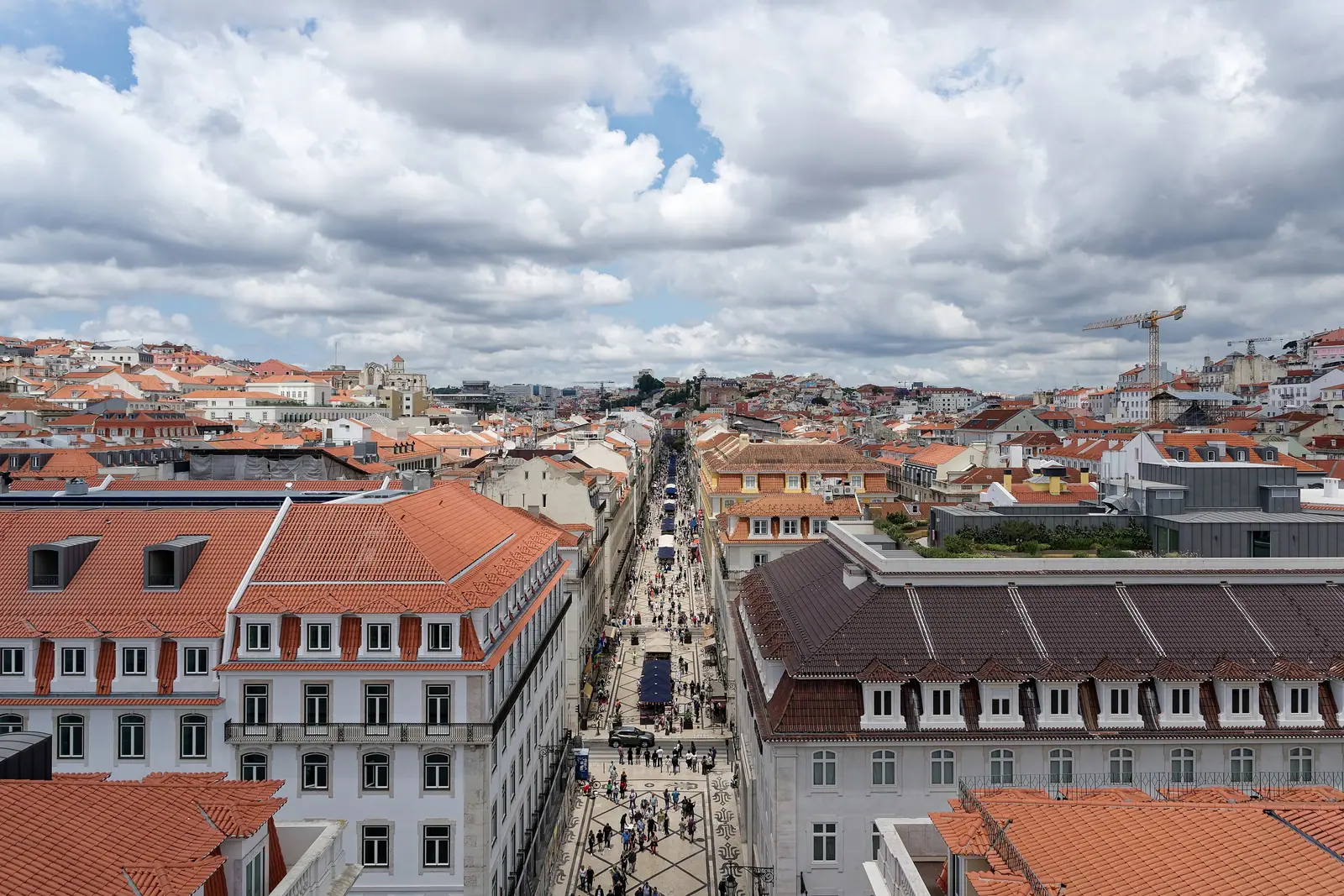
The proposals are signed by councillor Joana Baptista, who is responsible for public-space projects and works, and are on the agenda of the public meeting, according to Lusa. The first covers the 68 cameras, presented as the completion of the first phase, with a 180-day deadline. According to the council, they would cover Rossio, Praça da Figueira and the streets Augusta, do Ouro, da Prata, dos Fanqueiros and do Comércio.
The second, worth about €1.23 million and also with a 180-day deadline, would refit the electrical and monitoring installations of the PSP’s Lisbon Metropolitan Command (Cometlis). It would also equip the 1st Division to receive and record images.
The third lends the PSP 20 portable video cameras free of charge. The city bought them and they meet a request from the police itself; their value was not given. The fourth is a cooperation agreement with Cometlis for the second phase of the system.
The mayor, Carlos Moedas, says that “Lisbon residents’ safety is a priority and requires investment”, along with planning and cooperation with the police. The councillor says the council does not intend to take over the role of the security forces, which falls to the State. The city itself is making the investment, according to the council.
The Government’s authorisation and the data regulator’s opinion
Order 2644/2021 (opens in a new tab), signed on 1 March 2021 by the then deputy secretary of state for internal administration (home affairs), Antero Luís, authorised 216 cameras in 16 areas. They include Praça D. Pedro IV (the official name of Rossio), Praça da Figueira and the grid formed by the streets Augusta, Áurea (do Ouro), da Prata, dos Fanqueiros and do Comércio and the streets crossing them. These are the places the council now names.
The authorisation was renewed in 2023 and again this year. Order 13168/2026, by the secretary of state for internal administration, Telmo Correia, records that the PSP applied for renewal after the legal deadline, which falls 60 days before the authorisation lapses. It cites the public interest in keeping the system, but does not say how many cameras go to each area or mention a new opinion from the National Data Protection Commission (CNPD).
The CNPD’s opinion on Lisbon (opens in a new tab) dates from 16 December 2020, under the previous law. The regulator recommended that operators should not be able to switch off the masks covering windows and entrances, or to use sound recording. On the automated video analysis provided for in the equipment requirements, it concluded that, without defined criteria, proportionality could not be assessed.
The 2021 order requires doors, windows and balconies to be blocked from view, bans hidden cameras and discriminatory profiling, and allows sound recording only in a situation of concrete danger.
The CNPD’s list of 2026 opinions (opens in a new tab), with 73 entries on 24 November, includes video surveillance requests for Cascais, Tavira, Castelo Branco, Mourão and Lagos, and none for Lisbon.
The sums: cost and cameras still to come
Executive Digest gives €1.81 million for the 68 cameras. That is about €26,600 per camera, with no breakdown of equipment, installation, network connection and maintenance. With €1.23 million for the police installations, the total is €3.04 million.
The number of cameras already installed depends on what is counted. Lusa, citing the proposal, counts 133 in the first phase, with the Bairro Alto district included. Executive Digest, based on the council’s text, counts 106 installed between 2021 and 2026. The gap is 27, the number of cameras in Bairro Alto (opens in a new tab), which have been running since 2014 under their own authorisation and are not among the 16 areas. This is the newsroom’s own calculation: neither Lusa nor Executive Digest explains the gap.
With the 106, plus the 68, there would be 174 cameras, which is 42 short of the 216 authorised. With the 133 there would be 201, or 15 short. According to Lusa, work is being prepared at Praça do Comércio, Cais das Colunas, Santa Apolónia and the 5th Division, with no number of cameras given. On 20 November, the news outlet ECO reported tenders for more than 100 cameras in the Baixa Pombalina; the proposal described by Lusa mentions 68.
What the law requires
Video surveillance by the security forces is governed by Law 95/2021 (opens in a new tab) of 29 December. For fixed cameras, Article 5 requires authorisation from the member of the Government in charge of the requesting force, preceded by a CNPD opinion. The regulator has 60 days to issue it and, after that, the opinion is deemed favourable.
The authorisation sets the locations, the conditions and the duration, which is up to three years and renewable. It bans capturing sound except in concrete danger (Article 7). If the installation points or technical characteristics change, a new authorisation is needed (Article 8). The law bars capturing the inside of homes or occupied buildings and of hotels and similar premises, unless there is consent or a court authorises it. It also bars any capture that directly affects private and intimate life (Article 4).
Recordings are kept in coded form for 30 days at most (Article 19). The exceptions are those showing facts of criminal relevance, which go to the public prosecutor (Article 18). The law allows analytical management of the images but bans capturing and processing biometric data (Article 16). The data controller is the security force, including under contracts with third parties (Article 17), and the CNPD is the supervisor (Article 24).
Second phase: Martim Moniz and Mouraria
According to Lusa, the second-phase agreement gives “maximum priority” to Martim Moniz and Mouraria, with the Restauradores–Saldanha and Martim Moniz–Almirante Reis corridors and the approaches to São Jorge Castle. The proposal justifies this with “recent episodes of violence in public space” reported in the media. According to Executive Digest, the PSP identified Avenida da Liberdade, Martim Moniz and Mouraria, among others, as priority areas, and the agreement starts with technical studies. None of the three is among the 16 areas authorised in 2021.
In remarks to ECO (opens in a new tab), published on 20 November, Joana Baptista points to a total of 500 cameras in the city, in a plan that runs beyond 2029.
What is still unknown
- The result of the vote. Lusa writes that approval should be assured, because the city leadership, made up of the PSD, CDS-PP and IL parties, governs with an absolute majority after bringing in a councillor formerly of the Chega party. The Lusa and Executive Digest reports do not say where the opposition stands on the package.
- Match with the authorisation. It remains to be confirmed whether the installation points and characteristics of the 68 cameras are those authorised in 2021.
- Portable cameras. The councillor told ECO that body-worn cameras are being delivered to the PSP this month. These have their own rules (Article 10 of the law). It is not known whether they are these 20 or whether the general regime for portable cameras applies (Article 9).
- Timetable. The proposal sets 180 days to complete the work, with no known start date.
Sources
Documents and reporting consulted for this story.
- Câmara de Lisboa quer instalar 68 câmaras na Baixa por 1,8 milhões (opens in a new tab)Notícias ao Minuto (Lusa), . Accessed 24 November 2026
- Lisboa prepara 68 novas câmaras na Baixa e estuda expansão à Avenida da Liberdade, Martim Moniz e Mouraria (opens in a new tab)Executive Digest, . Accessed 24 November 2026
- Lisboa lança concurso para 100 câmaras de videovigilância e planeia chegar às 500 (opens in a new tab)ECO, . Accessed 24 November 2026
- Despacho n.º 13168/2026, de 28 de outubro: renova a autorização do sistema de videovigilância na cidade de Lisboa (opens in a new tab)Diário da República (Administração Interna), . Primary source. Accessed 24 November 2026
- Despacho n.º 2644/2021: autoriza a instalação e utilização do sistema de videovigilância no município de Lisboa (opens in a new tab)Diário da República (Administração Interna), . Primary source. Accessed 24 November 2026
- Parecer/2020/145: sistema de videovigilância na cidade de Lisboa (opens in a new tab)Comissão Nacional de Proteção de Dados (CNPD), . Primary source. Accessed 24 November 2026
- Lei n.º 95/2021, de 29 de dezembro (opens in a new tab)Diário da República (Assembleia da República), . Primary source. Accessed 24 November 2026
- Pareceres 2026 (opens in a new tab)Comissão Nacional de Proteção de Dados (CNPD). Primary source. Accessed 24 November 2026
- Governo autoriza renovação da videovigilância no Bairro Alto, em Lisboa (opens in a new tab)ECO, . Accessed 24 November 2026
Topics

Written by
Wellinton OliveiraCEO of Lyntev
Technology with context, original analysis and sources you can consult.