Iberifier alerts Meta and TikTok to posts that could lead to void ballots in Spain
On 19 November the Rapid Response System’s first notification of this election targeted posts urging voters to write on their ballot, which voids the vote. The platforms are not obliged to remove the content.
Key points
- On 19 November, ahead of Spain’s election on the 29th, Iberifier alerted Meta and TikTok to posts urging people to write a message on their ballot paper, which makes the vote void.
- It was the first notification to platforms from the Rapid Response System in this election, active until 6 December; two other cases were dismissed and one remains under review.
- Platforms need not remove the content but are expected to confirm receipt, and no authority can flag posts this way. The Digital Services Act lets the European Commission open proceedings and impose fines of up to 6% of annual worldwide revenue.
- Between 13 and 20 November the Comprobado 29N alliance published more than seventy fact-checks; the largest group of falsehoods concerns how to vote.
- The report does not say how many posts there were or how many people saw them, and it is not known whether Meta and TikTok replied.
Iberifier, the Iberian digital media observatory coordinated by the University of Navarra, warned Meta and TikTok on 19 November about posts urging voters to write a message on their ballot paper, which would make the vote void.
It was the first notification to the platforms since its Rapid Response System was switched on for Spain’s early general election, scheduled for 29 November. The details come from its third weekly report (opens in a new tab) and an interview the head of the fact-checking project EFE Verifica gave to the Portuguese news agency Lusa (opens in a new tab).
Iberifier’s consortium brings together 13 organisations from Spain and Portugal (opens in a new tab), among them Lusa and the Spanish news agency EFE, which runs EFE Verifica.
What the Rapid Response System is
The mechanism is set out in the European Union (EU) Code of Conduct on Disinformation. It can be activated in all 27 EU member states during election periods and is meant to monitor viral disinformation campaigns, coordinated manipulation and foreign interference, Lusa explains. This is the first time it has operated in Spain, run by Iberifier, which includes universities, research centres, news agencies and fact-checking organisations.
Taking part is voluntary, and neither the European Commission nor any other authority can flag content or accounts through it, according to the Code’s Transparency Centre (opens in a new tab).
The observatory’s preliminary report says the system runs from 1 November to 6 December, a week after polling day. The launch statement and Lusa put the start of monitoring on 2 November. On 24 November the vote was five days away.
What was reported to the platforms
The report describes the notification in a few lines: on 19 November Meta and TikTok were alerted to posts asking voters to write a message on their ballot, which makes the vote void. Meta owns Facebook, Instagram and Threads. The report does not identify who wrote the posts, nor does it say how many there were or how many people saw them.
Of the other cases assessed since the system was activated, two were dismissed and one is still under review. Any further notifications will be added to a public list of alerts (opens in a new tab), which on the afternoon of 24 November held only that entry and showed no reply from the platforms.
Why writing on the ballot voids the vote
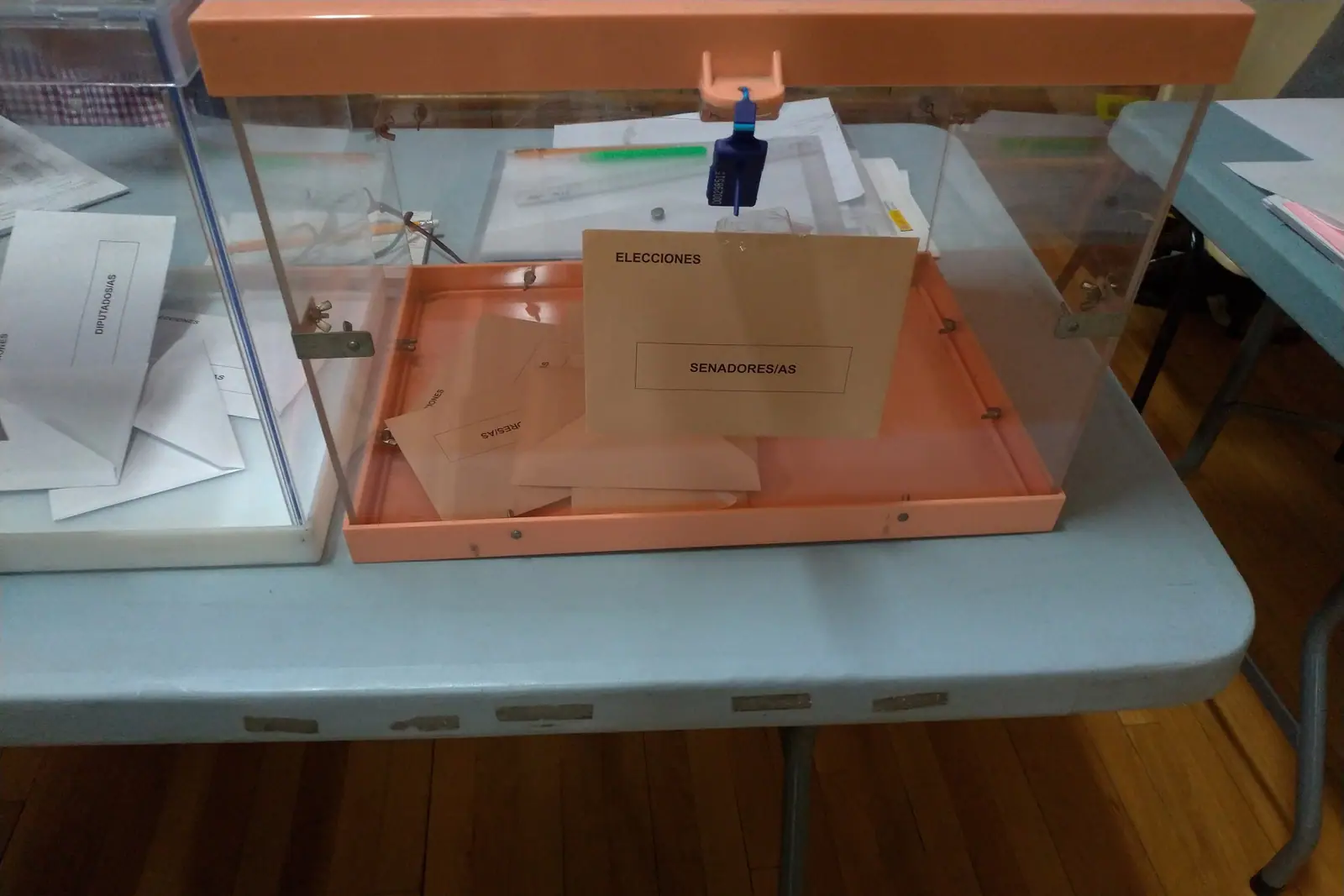
The call to write something on the ballot is the most visible example of the largest group of false or misleading content the fact-checkers logged: material about how to vote. Between 13 and 20 November the fact-checking alliance Comprobado 29N published more than seventy fact-checks and explainers. Some messages encouraged people to write a slogan on their ballot; others claimed that two ballots from different parties in one envelope count as two votes. The fact-checkers say both lead to a void vote.
They also explained that Senate ballots marked in advance and posted to voters by the parties are valid, and that striking out a candidate’s name voids the vote, as the Central Electoral Board has confirmed.
The three other groups of content
Besides content about how to vote, the report identifies three other groups. The second presents the electoral process as proof of fraud: irregular municipal-register entries were shared as a sign that people with no right to vote would take part, even though Spanish nationality is needed to vote in a general election.
The third covers polls and images. Some polls in circulation were fabricated or attributed to the wrong source, and campaign images generated with artificial intelligence (AI) were shared as if real. The fact-checkers also point to Matryoshka, a Russian operation, which they say targeted these elections with stories on Catalan separatism, the housing crisis and the collapse of Europe.
The fourth group concerns what candidates say. Fact-checkers found inaccurate or outdated figures on immigration, housing and the economy, many in long online interviews, and note that some widely shared claims about politicians were true. On the only face-to-face debate, held on 19 November, the report says some of the two candidates’ figures were accurate and others misleading or false. In most cases the problem lay in how the data were chosen, rounded or framed.
What the platforms must do
The platforms are not obliged to remove the content they are notified about. They are expected, however, to reply to Iberifier confirming that they received the information, writes Lusa, which interviewed Sergio Hernández, head of EFE Verifica. They are alerted, Hernández said, so that they act in line with their own rules and the law.
Iberifier’s coordinator, Ramón Salaverría, said at the launch that the system does not restrict freedom of expression or give anyone the power to order content deleted. He added that neither governments nor the European Commission take part in identifying it.
Legal pressure comes from elsewhere. Under the Digital Services Act, the European Commission can open proceedings against platforms it judges to be failing on false content. Fines can reach 6% of annual worldwide revenue, Lusa writes. Neither the report nor the interview says that this notification has led to such proceedings.
What to expect before polling day
Hernández warned that disinformation tends to grow as elections approach and that the last 72 hours before the vote are critical. Counted back from 29 November, they begin on 26 November.
In electoral processes, Hernández said, the disinformation seen most often is Russian, according to the European Union. He accepts there may be foreign interference this time too, but says attributing the origin of a false item is “complicated”.
The preliminary report, dated 1 November, sets the background: in Spain, trust in news stands at 33%, and 74% of the population is concerned about telling true from false information online. It summarises 8,086 fact-checks from 2023 to 2026 and names five risk vectors, among them foreign interference, generative AI and opaque private messaging channels.
What is still unknown
- Whether Meta and TikTok replied to Iberifier and whether they removed, limited or left up the posts.
- How many posts were reported, where they circulated and how many people saw them.
- Whether the case still under review leads to a new notification before 29 November.
- What new alerts appear on Iberifier’s public list by 6 December.
Corrections
. Corrected on 24 November: the text said 74% of people in Spain worry about telling true from false. The report’s figure refers to concern about telling true from false information online.
Sources
Documents and reporting consulted for this story.
- Spain general election 2026: Weekly report no. 3 (14-20 Nov.) (opens in a new tab)Iberifier, . Primary source. Accessed 24 November 2026
- Preliminary Report ahead of 2026 General Elections in Spain (opens in a new tab)Iberifier (Universidade de Navarra), . Primary source. Accessed 24 November 2026
- Meta e TikTok alertadas sobre conteúdos que podem anular votos em Espanha (opens in a new tab)Lusa, via Notícias ao Minuto, . Accessed 24 November 2026
- IBERIFIER comienza a monitorizar la desinformación electoral del 29N en el marco del Sistema de Respuesta Rápida europeo (opens in a new tab)Iberifier, . Primary source. Accessed 24 November 2026
- Notificaciones RRS: alertas a plataformas, elecciones 29N (opens in a new tab)Iberifier. Primary source. Accessed 24 November 2026
- Rapid Response System for elections: questions and answers (opens in a new tab)Centro de Transparência do Código de Conduta sobre Desinformação. Primary source. Accessed 24 November 2026
Topics

Written by
Wellinton OliveiraCEO of Lyntev
Technology with context, original analysis and sources you can consult.