Guterres asks states to build a global framework for AI risks within a year
At the close of the Bridgetown summit, the UN Secretary-General argued for a common safety foundation with independent oversight. According to the UN, it is not a treaty. A day later, Australia and Singapore agreed to co-operate on AI.
Key points
- On 23 November 2026 in Bridgetown, António Guterres asked member states for a multilateral framework to manage AI risks, with independent and credible oversight.
- The deadline requested is one year, according to the news agencies AFP and Xinhua; the UN’s news service speaks of starting talks on the framework.
- According to a UN envoy, it is neither a treaty nor regulation but a structure each country can use to build its own AI safety infrastructure.
- The summit issued the Bridgetown Call to Action, which urges more investment in AI capacity in the Global South; no negotiated outcome was planned.
- On 24 November, Australia and Singapore agreed in Canberra to step up co-operation on AI and cybersecurity.
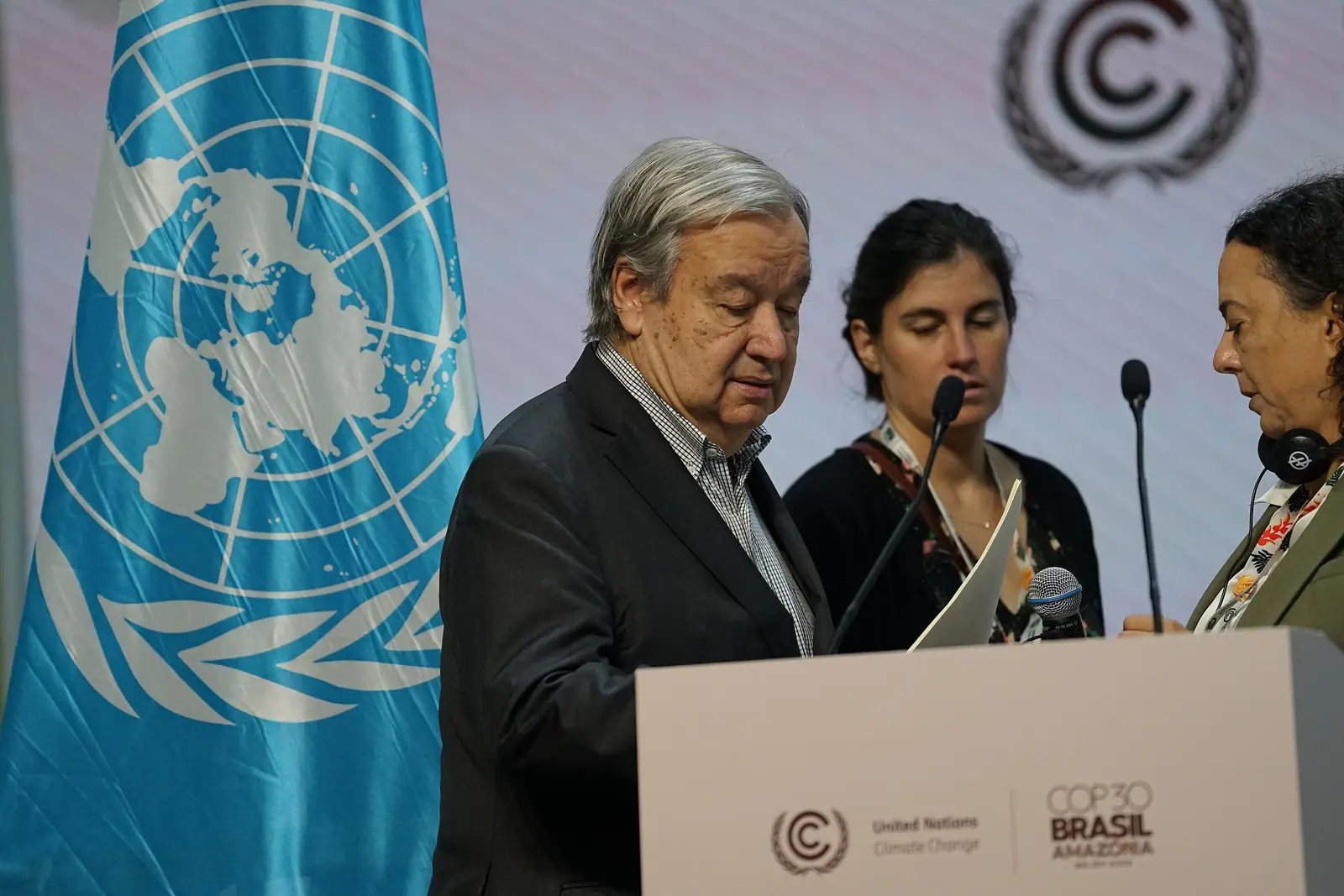
United Nations Secretary-General António Guterres called on Monday, 23 November, for member states to draw up within a year a shared global framework for handling the risks of artificial intelligence (AI), with independent oversight. He made the appeal at the close of the Special Summit on AI Safety in Bridgetown, Barbados. According to a UN envoy, it is neither a treaty nor regulation. Guterres suggests starting with common safety measures, a testing regime and basic oversight requirements.
What Guterres asked for in Bridgetown
Guterres spoke to reporters at the close of the summit, organised by the UN and Barbados. According to the news agency AFP (opens in a new tab), he asked states to work together and build, within the next year, a multilateral framework for managing AI risk. It should rest on principles, be open to the whole world and have credible independent oversight.
UN News (opens in a new tab) describes the request more cautiously: a call for states to begin discussions on such a framework. No date was given; a year from the appeal ends in November 2027. The Chinese news agency Xinhua (opens in a new tab) adds that the Secretary-General wants a shared understanding of emerging risks, independent ways of evaluating powerful systems and more transparency about serious incidents and near misses.
A framework, not a treaty
Before the summit, the UN Special Envoy for Digital and Emerging Technologies, Amandeep Singh Gill, explained that the proposal is “not a treaty, it’s not regulation”. He described it as a structure each country can use to build its own national AI safety infrastructure. The UN (opens in a new tab) also said no negotiated outcome was planned, only calls to action and pledges.
Gill pointed to the practical reason: many countries lack the capacity to test models built elsewhere or to respond to incidents. The World Development Report 2026, he noted, counts 500 incident response teams in high-income countries and only six in low-income ones.
The diagnosis: concentrated power and scattered protections
Guterres said protections against AI risks remain fragmented and that governments too often react late. In his view, AI is bringing about the biggest transfer of power in human history, from states and institutions to a small number of companies and individuals. He believes that bodies set up after the Second World War, the UN among them, are not properly equipped today for that change.
On autonomous weapons, he repeated his support for a ban: the idea of a machine choosing whom to kill is, he said, “absolutely unacceptable”. He added that the ability to turn AI into a weapon sits with just two countries and a handful of companies. The UN (opens in a new tab) had already warned that the summit’s discussions would not cover military uses.
What came out of the summit
The summit ended with the Bridgetown Call to Action on AI Safety for Humanity, which urges governments, businesses, financial institutions and foundations to invest more in AI capacity in the Global South, according to Xinhua. Barbadian Prime Minister Mia Mottley said participants had asked for support for an international initiative to keep the most advanced models under human control. They also proposed shared regional pools of graphics processing units (GPUs), the chips used to train and run AI models.
Guterres proposed a Global Fund for AI Capacity-Building. Asked whether her government should be able to cut off access to AI models in an emergency, Mottley said yes, adding that it must be a condition of purchase, according to the UN.
The obstacles: the United States, China and industry
AFP writes that international regulation of AI looks like little more than a pipe dream while the United States and China compete for the lead. In the United States, the agency says, regulators are unlikely to intervene: in September, President Donald Trump hosted executives who agreed to a voluntary code of conduct on AI safety.
Also in September, according to AFP, the chief executives Dario Amodei of Anthropic, Sam Altman of OpenAI and Elon Musk of SpaceX called for a slowdown in AI development. Nvidia’s Jensen Huang and Meta’s Mark Zuckerberg, by contrast, want to press ahead at full speed.
Before the summit, the UN announced that the United States would send a senior diplomat and that Chinese experts were expected.
Australia and Singapore, a day later
On Tuesday, 24 November, Australia and Singapore agreed in Canberra to step up co-operation on AI and cybersecurity, in a joint declaration by prime ministers Anthony Albanese and Lawrence Wong, according to the Portuguese news agency Lusa (opens in a new tab). The two governments want to share knowledge on evaluating and certifying models and to build mechanisms for detecting and reducing risks. They also committed to promoting international standards for safe, responsible and transparent development.
Albanese said the two countries will work to shape regional and global approaches to AI while keeping the technology under human control. Lusa mentions no link between this agreement and Guterres’s appeal.
What is still unknown
It is not yet known which states will agree to negotiate the framework, who will lead it or how the independent oversight would be made up. Guterres leaves office at the end of December, and his successor, who takes over in the new year, has not yet been chosen, according to AFP. Guterres said he will tell his successor that AI must be properly controlled if humanity is to keep control of the world.
Sources
Documents and reporting consulted for this story.
- UN chief urges talks on global AI safety framework, warns of historic shift in power (opens in a new tab)UN News (Nações Unidas), . Primary source. Accessed 24 November 2026
- Bridgetown AI summit to tackle safety as risks outpace capacity to respond (opens in a new tab)UN News (Nações Unidas), . Primary source. Accessed 24 November 2026
- UN chief calls for AI risk management framework within a year (opens in a new tab)AFP, via CP24, . Accessed 24 November 2026
- Guterres calls for multilateral framework to manage AI risks worldwide (opens in a new tab)Xinhua, . Accessed 24 November 2026
- Austrália e Singapura unem esforços para regular e proteger sistemas de inteligência artificial (opens in a new tab)Lusa, via Observador, . Accessed 24 November 2026
Topics

Written by
Wellinton OliveiraCEO of Lyntev
Technology with context, original analysis and sources you can consult.