Nvidia reinstates Jensen Huang as CEO 11 days after announcing his exit; inquiry still open
The board voted unanimously after hearing from the US government, and Donald Trump says he made the deal. Monday’s surge in the shares gave way to a fall before Tuesday’s open, while Washington put Nvidia’s customer Megaspeed on its export restrictions list.
Key points
- Nvidia’s board reinstated Jensen Huang as president, CEO and director on 23 November 2026, six days after saying it did not intend to do so.
- The company says it heard from US government officials and that there is no national security risk; the independent directors’ investigation goes on.
- Donald Trump told CNBC he made the deal for the return and that the government gave the board assurances. Nvidia’s statement does not mention him.
- The shares closed 30% higher on Monday, according to CNBC, and were down 5.4% at 10:44 GMT on Tuesday, before the market opened.
- The Commerce Department added seven companies to its export restrictions list, three of them bearing the Megaspeed name. Megaspeed denies wrongdoing.
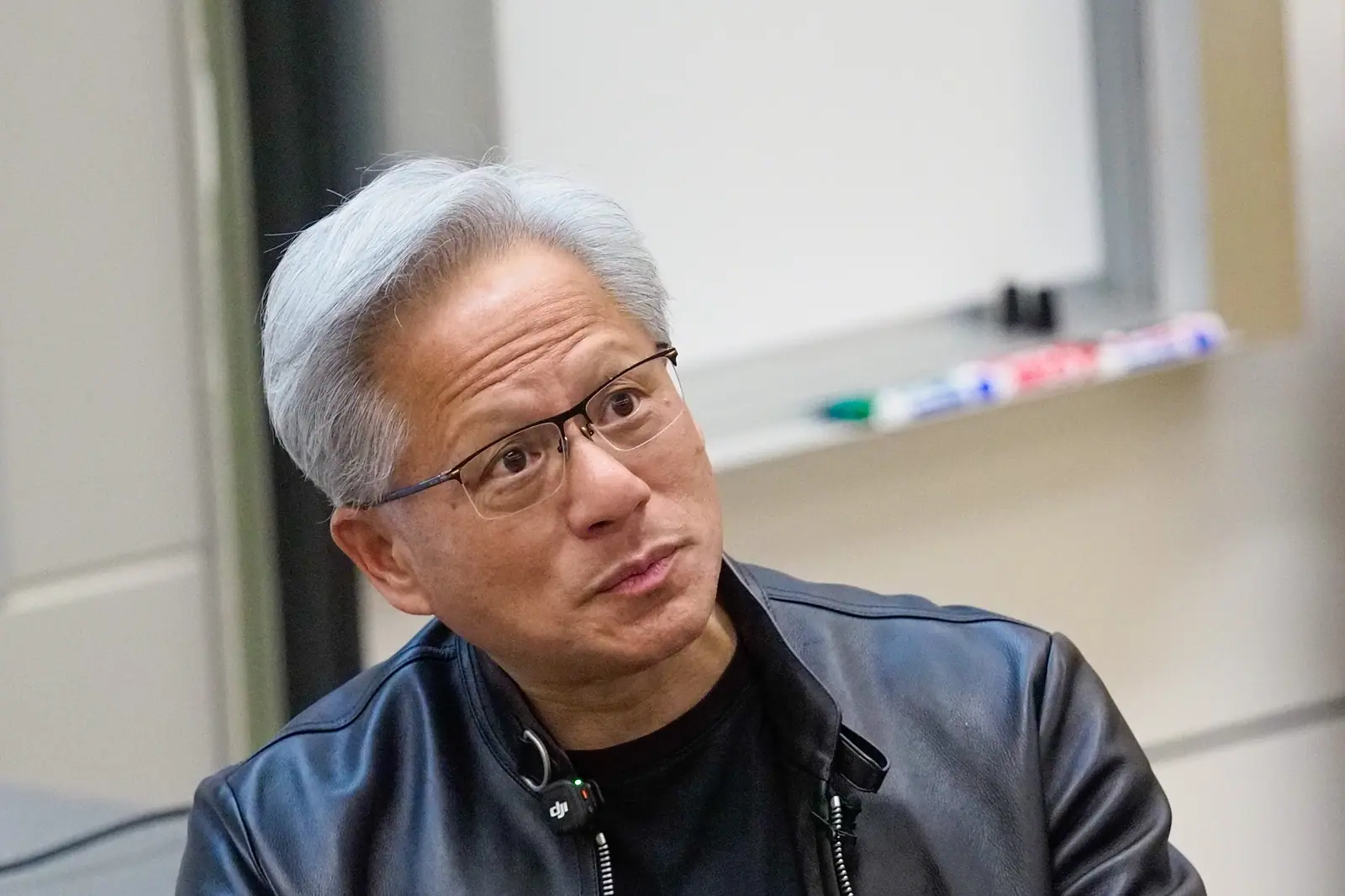
Nvidia put Jensen Huang back in charge on Monday 23 November, restoring him with immediate effect as president, CEO and member of the board. The vote was unanimous, according to the company’s statement (opens in a new tab), issued at 13:55 GMT. It came 11 days after his resignation was announced and six days after the same board said it had no intention of bringing him back (opens in a new tab).
The case touches on the governance of one of the world’s most valuable companies, a designer of chips for artificial intelligence (AI) systems. It also involves the intervention of a US president and the policing of advanced chip sales to China. Hours after the announcement, the US Commerce Department restricted exports to Megaspeed, an Nvidia customer under investigation over the possible diversion of those chips.
What Nvidia’s board decided
The board says it voted after several conversations with Huang and came away satisfied with his candour and his capacity to run the company. It adds that it heard from senior levels of the US government and that, on that basis, it is confident that his return carries no national security risk. The statement neither names those who spoke nor describes what they said.
The return comes with new checks. Harvey Jones stays on as chair of the board. A committee of independent directors, assisted by outside lawyers, is continuing an investigation opened after reports that Huang may have been targeted by a foreign intelligence operation. The company says that work will be completed and that Huang has undertaken to co-operate.
There is also a committee on national security and export controls, and a search has begun for a chief compliance officer, a new post at Nvidia. Colette Kress, the chief financial officer, gives up the interim leadership she had combined with that job.
How Jensen Huang left in November
Huang, who co-founded Nvidia in 1993, left the company in November. The filing with the SEC (opens in a new tab), the US markets regulator, dates the acceptance of his resignation to the 11th; the announcement followed on the 12th without giving a reason. On the 17th the board’s chair, Harvey Jones, said Huang had left voluntarily after revealing “personal behaviour” at odds with the code of conduct, according to the public radio network NPR (opens in a new tab). The BBC (opens in a new tab) writes that he was forced to resign.
The matter had already become political in October, when the press reported Huang’s connection with a former executive of Megaspeed, a Singapore company that buys Nvidia chips.
The BBC (opens in a new tab) reports that US intelligence suspected the former executive of working for Beijing. China denies it and has warned Washington against using the case as an excuse for a technology blockade. The suspicion is unproven. According to CNBC, the United States is investigating the former executive and Megaspeed.
Donald Trump tells CNBC he made the deal
Trump said on Monday, on CNBC’s Squawk on the Street, that he had talked to the board before it changed course. “I made the deal,” he said. In his account, the directors asked for guarantees on national security and the government provided them, “at least with everything we know”. The danger, he added, would lie in losing Huang, not in having him.
Nvidia’s statement confirms the contact with the government but does not mention Trump. It cites the interests of shareholders, staff, partners and customers.
The president’s financial interest has also entered the debate. A BBC analysis of his financial disclosures over the past two years found purchases of Nvidia shares worth $23 million to $86 million, in 85 transactions. It also found 19 sales that brought him between $3.5 million and $10.2 million.
Trump and the White House reject claims that he has profited from office. The president says he makes no decisions on those accounts, and the White House points out that his businesses sit in a trust run by his sons.
Nvidia shares jump 30% and slip before the open
The shares ended Monday’s session up 30%, according to CNBC; the BBC puts the rise at 31%, with almost $1 trillion added to the company’s market value. The gain did not wipe out earlier losses: the BBC writes that Huang’s departure had cut the price by more than 30% and that it is still lower than a month ago.
On Tuesday 24 November the direction reversed. At 10:44 GMT (5:44 in New York), the stock was down 5.4% in trading ahead of the opening bell, CNBC reported. Micron, Marvell, AMD and Arm were off by more than 3%. These are provisional figures that regular trading may change.
Among analysts, Mizuho sees investors’ confidence in the artificial intelligence trade returning. Bank of America is more cautious: “Reinstatement should not be confused with the end of scrutiny,” it wrote, in a note expecting continued attention to governance, China and compliance.
Megaspeed goes on the export restrictions list
Monday’s other decision is set out in a final rule from the Bureau of Industry and Security (opens in a new tab) (BIS), part of the Commerce Department. It adds seven companies to the Entity List, the register of organisations subject to restrictions: Speedmatrix, MSFusion and PT Megaspeed International in Malaysia; Megaspeed International, Swiftdata and Apex Enterprise Solutions in Singapore; and Megaspeed (Thailand) in Thailand.
The stated reason is a significant risk that advanced computing equipment will be diverted to users or uses that are not authorised. Any product covered by US export rules now needs a licence to reach these companies, and applications start from a presumption of refusal. Re-exports are included, so suppliers in other countries are affected. Shipments already on their way may continue if they arrive within 30 days.
Being listed is an administrative decision based on reasonable grounds for seeing a risk; it is not a conviction. The document does not mention Nvidia, Huang or China. According to the BBC, China has been barred from buying this technology since 2022 and the Commerce Department has been looking into Megaspeed for almost two years. The company denies wrongdoing, according to TechCrunch (opens in a new tab), which also reports a criminal investigation announced last week and inquiries in Singapore.
Accounts differ on the date. The BBC wrote that the announcement did not say when the restriction takes effect. The rule sets it at the date of public inspection, which the Federal Register, the US government’s official journal, records as 21:15 GMT on 23 November.
What Congress does next and what is still unknown
Huang is due at a closed-door interview with three House of Representatives committees on 1 December. The Senate Banking Committee has called him for 3 December.
Criticism comes from both parties. The Democrat Elizabeth Warren, expected to lead that committee from January, called the reinstatement “reckless”. The Republican Tom Cotton, who chairs the Senate Intelligence Committee, said the matter is not settled by Huang getting his job back.
It is not known what assurances the government gave or on what grounds, when the independent directors will finish their investigation, or whether the findings will be published. Nor is it clear how the restrictions on Megaspeed will affect Nvidia’s sales.
Corrections
. The date of Jensen Huang’s resignation has been corrected: the SEC filing shows it was accepted on 11 November and announced on the 12th. The headline, the timeline and the account of the departure were changed.
Sources
Documents and reporting consulted for this story.
- NVIDIA Board Reinstates Jensen Huang as President, CEO and Board Director (opens in a new tab)Nvidia, . Primary source. Accessed 24 November 2026
- Additions to the Entity List (2026-23999) (opens in a new tab)Federal Register, Bureau of Industry and Security, . Primary source. Accessed 24 November 2026
- US to blacklist Asian AI firm Megaspeed after Nvidia scandal (opens in a new tab)BBC News, . Accessed 24 November 2026
- Trump faces backlash after he 'convinced' Nvidia to reinstate Jensen Huang (opens in a new tab)BBC News, . Accessed 24 November 2026
- Nvidia shares fall over 5% in premarket after Huang comeback rally (opens in a new tab)CNBC, . Accessed 24 November 2026
- Megaspeed, the company at the center of the Jensen Huang scandal, appears headed for a US blacklist (opens in a new tab)TechCrunch, . Accessed 24 November 2026
- Form 8-K da NVIDIA (data do facto: 11 de novembro de 2026; entregue a 12) (opens in a new tab)NVIDIA / SEC, . Primary source. Accessed 24 November 2026
- Nvidia board says it does not intend to reinstate Jensen Huang as CEO (opens in a new tab)NPR / NHPR, . Accessed 24 November 2026
Topics

Written by
Wellinton OliveiraCEO of Lyntev
Technology with context, original analysis and sources you can consult.