Ladybird browser reaches alpha on macOS and Linux with its own engine, no security promises
After more than four years in development, the independent browser can now be downloaded. The project warns that it crashes, is not ready for everyday use and comes with no security promises.
Key points
- Ladybird, a browser with a rendering engine written from scratch, has been in alpha for macOS and Linux since 23 November.
- Its lead developer, Andreas Kling, warns that some sites do not work, that it sometimes crashes and that he makes no security promises at this stage.
- The alpha updates itself automatically and supports WebDriver and the Firefox developer-tools protocol, for people who build sites.
- A Windows version comes later, according to The Verge; the project took more than four years to reach alpha.
- Under its privacy policy, the organisation does not track browsing. Crash reports and the IP addresses they came from are kept for up to 93 days.
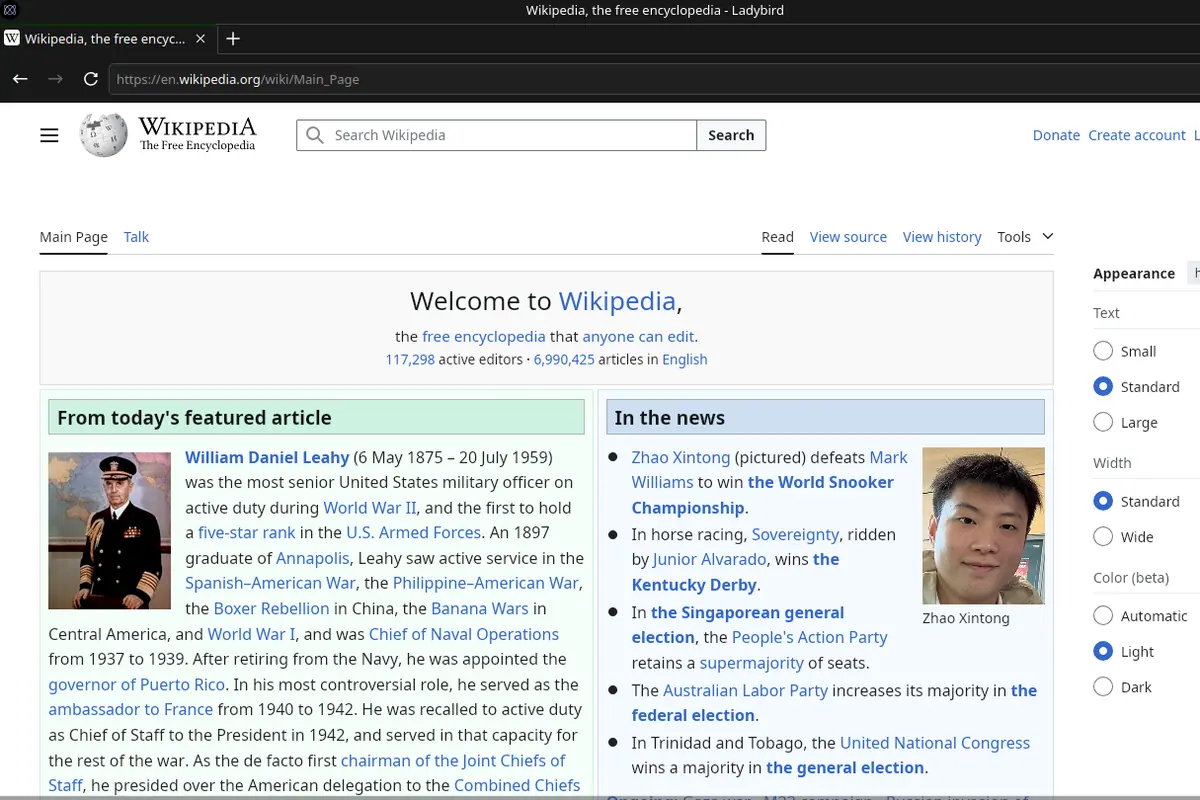
Ladybird, a browser that runs on a rendering engine written from scratch, can now be downloaded for macOS and Linux as an alpha, an early test version that is still unfinished. Andreas Kling (opens in a new tab), the developer who leads the project, announced it on 23 November and warned that some sites will not work, that the program crashes from time to time and that he makes no promises about security.
The project itself says it is not ready yet (opens in a new tab) to replace an everyday browser. For the web, it is a rare attempt to add a fourth engine to the three behind the most popular browsers.
What was released
The rendering engine is the part of a browser that reads a page’s code and turns it into what you see. According to The Verge (opens in a new tab), the most widely used browsers rest on three: Gecko, in Firefox; WebKit, in Safari; and Blink, in Chrome, Edge and Opera. Blink began as a fork of WebKit, a copy of the code that went its own way.
Ladybird has its own engine, “built from the ground up, and not a fork”, in Kling’s words. The browser around the engine is, he writes, “modest, but functional”.
The project took more than four years to get here, according to The Verge. A Windows version is left for a later stage. The download page (opens in a new tab) lists a disk image for macOS. For Linux there is a Flatpak package, installation on Ubuntu and Fedora and a standalone archive, which does not update itself. It is also possible to build the program from source.
What Kling says does not work yet
Some sites do not work and the browser sometimes crashes, Kling writes. When that happens, users can read the crash report before deciding whether to send it, and can flag a broken site from inside the browser.
On security the warning is explicit: a new browser “gets hacked, over and over”, that is part of the process and, for now, the team makes no promises. Kling asks security researchers to try to break in and say how.
Progress is measured with the Web Platform Tests, a suite that checks browsers against web standards. The project says it ended October at about 2.18 million subtests (opens in a new tab) and that on the 26th it overtook Safari Technology Preview, the trial version of Apple’s browser.
Automatic updates and testing for web developers
The alpha is a rolling channel: it receives automatic updates regularly. Until now, anyone who wanted to see progress had to build the program.
Kling asks people who build websites to try theirs and report what breaks. The browser supports WebDriver, used for automated testing, and the Firefox developer-tools protocol.
Who is behind it and what data it collects
Ladybird is developed by the Ladybird Browser Initiative, a United States non-profit with an address in San Francisco that relies on donations and sponsorships. It says it has no default search deals or other ways of making money from users. It adds that sponsors have no say in where the product goes and that it strives to keep 18 months of funding in hand at all times.
According to its privacy policy (opens in a new tab), the organisation does not track browsing or sell data. Crash reports are sent only if the user chooses to send them and include the version, the operating system, the error message and the stack trace, a technical record of the crash; the page address is optional. The organisation keeps them, along with the IP addresses they came from, for up to 93 days.
Reports of broken sites carry the page address and a screenshot, which the user can remove. When they are accepted, their content, minus the IP address, becomes public on the GitHub platform. Update checks send the version and platform, and downloads go through Cloudflare. The information is processed in the United States.
AI in the code and closed contributions
The Verge says the project began in the C++ language and later moved to porting code to another, Rust, with the help of AI. In February Kling said, according to The Register (opens in a new tab), that he had used Claude Code and Codex, two AI coding assistants, to translate the JavaScript interpreter. It came to about 25,000 lines in two weeks, with output identical to the original code. By hand, he said, it would have taken months.
Kling described the work as directed by a person, in hundreds of short prompts. In October the project set AI agents to fill in missing functionality.
AI also weighed on the decision to close the project to outside changes. On 5 June Ladybird stopped accepting code from the public (opens in a new tab): only its maintainers may change the browser’s code, which remains open to inspection under an open-source licence. Kling wrote that, with these tools, a contribution no longer says as much about the person sending it. Another open project, LibreOffice, kept contributions open and tightened its rules for AI-assisted code on 24 November.
What this changes in Europe and what is still unknown
The alpha is for computers only. The project says mobile platforms are not a current focus and that more effort will go into Android and iOS once the desktop versions are in good shape. On the iPhone, the argument is being had in Brussels: Mozilla, Vivaldi and Brave are asking the European Commission for formal proceedings against Apple over browser engines.
It is not yet known when the Windows version will arrive, what share of everyday sites works or whether donations are enough to sustain an engine of its own. The Verge describes that engine as the first entirely new one in years. The announcement gives no timetable for a stable release.
Sources
Documents and reporting consulted for this story.
- Ladybird is now in alpha (opens in a new tab)Ladybird Browser Initiative (Andreas Kling), . Primary source. Accessed 24 November 2026
- Download for macOS and Linux (opens in a new tab)Ladybird Browser Initiative. Primary source. Accessed 24 November 2026
- Privacy policy (opens in a new tab)Ladybird Browser Initiative. Primary source. Accessed 24 November 2026
- Organization (opens in a new tab)Ladybird Browser Initiative. Primary source. Accessed 24 November 2026
- Ladybird, the first new browser engine in years, is now available to test (opens in a new tab)The Verge, . Accessed 24 November 2026
- Ladybird indie web browser flutters toward Rust (opens in a new tab)The Register, . Accessed 24 November 2026
- Ladybird: frequently asked questions (opens in a new tab)Ladybird Browser Initiative. Primary source. Accessed 24 November 2026
- Changing How We Develop Ladybird (opens in a new tab)Ladybird Browser Initiative (Andreas Kling), . Primary source. Accessed 24 November 2026
- This Month in Ladybird - October 2026 (opens in a new tab)Ladybird Browser Initiative, . Primary source. Accessed 24 November 2026
Topics

Written by
Wellinton OliveiraCEO of Lyntev
Technology with context, original analysis and sources you can consult.